Theory-based Evaluation
The Zero-Dose Learning Hub theory-based evaluation collection brings together the core resources for understanding how and why immunization programs achieve their results, especially for strategies designed to identify and reach zero-dose and under-immunized children. This page features the Designing and Evaluating Zero-Dose Programs with Theory-Based Approaches: A Toolkit alongside the companion blog and country case studies that illustrate how theory-based evaluation and theories of change can strengthen real-time decision-making and program adaptation. Together, these materials offer governments, partners, and implementers practical guidance to clarify causal pathways, articulate assumptions and risks, and assess how context shapes program outcomes. Whether teams are designing new strategies, revisiting existing approaches, or evaluating results, these resources support a deeper understanding of the mechanisms behind change, helping practitioners improve and scale what works.
What is Theory-Based Evaluation?
Theory-based evaluation is a broad term encompassing methodological approaches that help in understanding and evaluating how and why a program or intervention functions by analyzing its underlying logic and assumptions. These approaches help evaluators and program staff not only determine whether a program works, but also explore how and why it does (or does not) work, offering actionable insights for improving program design and implementation.
 Importance of Theory-Based Evaluation
Helps to guide the decision-making process and provides a framework for understanding what works and what needs improvement.
Useful for assessing program progress toward intended objectives as well as gaps/challenges and solutions.
Promotes the development of solutions to meet actual needs.
Helps ensure that program activities are conducted in a way that will lead to desired results by considering the underlying theories that inform the program design.
Allows for the use of evidence-based strategies to achieve desired outcomes and adjust programming based on findings.
Provides an opportunity to consider the underlying assumptions on which the program is based and identify potential areas for improvement or expansion, which can help inform further development of the program and increase its overall success.
Facilitates the use of findings by documenting, in the form of a framework, how a program met objectives.
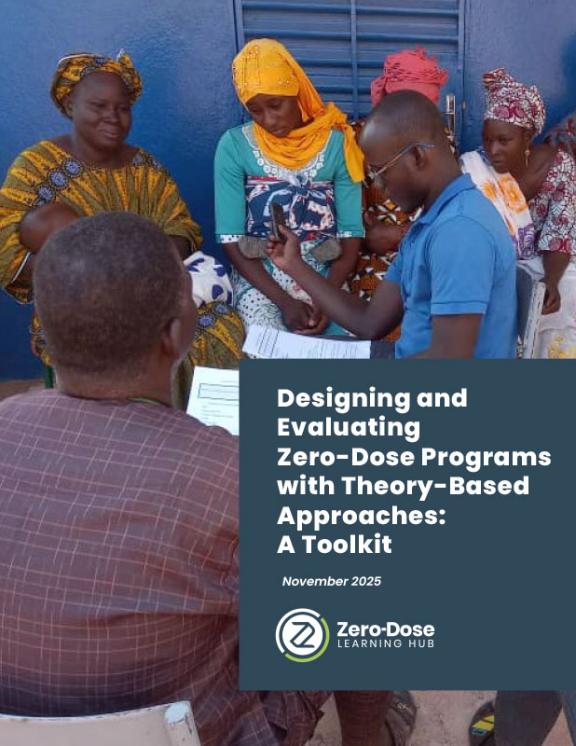
Designing and Evaluating Zero-Dose Programs with Theory-Based Approaches: A Toolkit
This toolkit offers practical guidance for designing, implementing, monitoring, and evaluating immunization efforts aimed at identifying and reaching zero-dose and under-immunized children using theory-based approaches. It helps government teams, partners, and donors build clear, evidence-informed measurement plans grounded in theories of change that map causal pathways from activities to outcomes. The resource shows how theory-based evaluation clarifies how and why programs work by making assumptions visible, examining context, and documenting the links between actions and results. As a plain-language guide, it walks users through developing and revisiting theories of change, assessing progress, and adapting strategies in complex environments to strengthen routine immunization systems.
From “Did It Work” to “Why Did It Work?” – How Theory-Based Evaluation Strengthens Immunization
This blog highlights why asking only whether an immunization program worked is no longer enough, and how theory-based evaluation helps uncover the causal pathways, assumptions, and contextual factors behind program results. It highlights country examples showing how theories of change can strengthen design, real-time adaptation, and decision-making, especially for strategies reaching zero-dose and under-immunized children.
What is a Theory of Change?
A framework used for program implementation and measurement that provides an explicit description of how and why a program is expected to lead to specific results. It lays out the causal pathways from inputs and activities through intermediate outcomes to long-term goals, including the assumptions, contextual factors, and causal linkages along the way.
 Country Learning Hub Case Studies
The Uganda Learning Hub met to review their theory of change (TOC) and add more detail for an evaluation of a local partner’s immunization intervention. The intervention focused on engaging local leaders to advocate for immunization programming to reach ZD and UI children. The discussion revealed the program hadn’t articulated how it intended to reach ZD and UI children or the important assumptions behind its strategy. For example, how would leaders advocate for immunization? Would advocates focus on education and sensitization about the importance of immunization for caregivers of ZD and UI children? Or, if vaccine hesitancy due to fear of side effects was the main barrier, would the community leaders focus on issues of safety to help reassure caregivers? These are examples of a few of the many essential but unanswered questions. The team agreed that the best approach would be to work through these questions with the implementing partner, noting that this would be helpful not only from the evaluation/measurement perspective but also to guide the implementer’s programming. Thinking through the causal pathways together would help the implementing partner design a more focused program that better met the community’s needs.
The Bangladesh Learning Hub experienced firsthand the need to pivot and adapt programming in 2024. The Learning Hub was supporting a number of programs to identify and reach ZD and UI children in various districts across the country using strategies such as expanded outreach and extended health facility hours. Additionally, the Learning Hub worked closely with the government’s Expanded Programme on Immunization (EPI) counterparts to advocate for services for ZD and UI children by regularly presenting on evidence gathered through their work. In July and August 2024, the country experienced widespread political upheaval and violence, ultimately resulting in the prime minister’s resignation and the fall of the ruling party. During the unrest, curfews and other restrictions on movement were implemented, preventing health workers from conducting the Learning Hub’s additional outreach sessions and the cancellation or postponement of other program activities. Furthermore, shifts in top government leadership led to changes at EPI and other agencies where the Learning Hub had established relationships. In one case, the national EPI contact responsible for coordinating with the Learning Hub changed twice in a short period. As a result, the Learning Hub was forced to rapidly adapt their implementation plans and advocacy strategies. The team kept track of where sessions had been canceled and children may have been missed, and they conducted more focused outreach efforts in these areas once they received permission to move around. Additionally, the Learning Hub worked quickly to engage with new leadership as the turnover occurred to ensure that new staff were familiar with the Learning Hub and its objectives. The rapid action taken by the Learning Hub helped limit the impact of the conflict on ZD and UI children. Data from the quarter showed that while there was a noticeable dip in coverage during the unrest, immunization coverage rebounded in some areas to above where it had been before the unrest, suggesting that the response was effective.
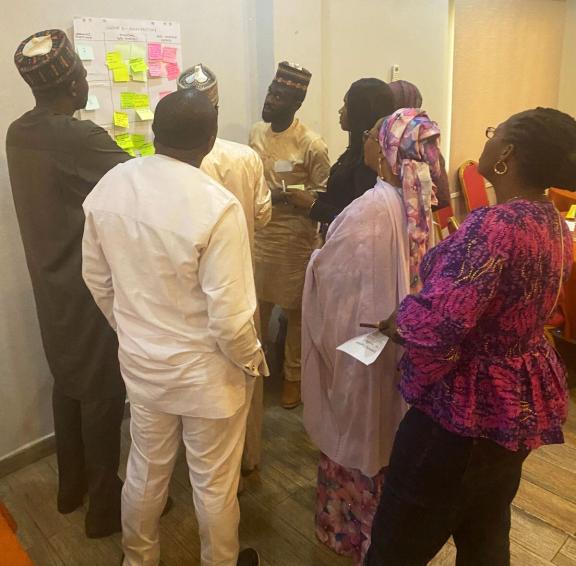
Across the Gavi-funded country learning hubs (CLHs), collaborative TOC processes have proven to be a valuable tool in ensuring ownership, alignment, and adaptability when designing country-led implementation research of targeted interventions to reach ZD children. In Mali, for example, the CLH coordinated a collaborative process under the leadership of the Centre National d’Immunisation to design, refine, and validate the TOC which provided a framework for assessing the ZD interventions through their implementation research. The TOC provided the foundational step for understanding how the interventions were supposed to work. National and subnational workshops engaged government, district health teams, civil society, and partners to jointly map pathways. They identified barriers across different district typologies, and streamlined innovations such as Coach2PEV, a digital supportive supervision tool, and MEDEXIS, an electronic logistics management information system, with the country’s Full Portfolio Planning, Gavi’s framework for aligning national priorities with partner support. This participatory approach fostered ownership and ensured the TOC became a living framework that guides implementation research, learning products, and real-time adaptation. Mali’s approach illustrates a principle that resonates across all CLHs: a TOC is most effective when co-created, grounded in country systems, and adaptable to new evidence. Similar collaborative approaches for developing TOCs of ZD interventions in Bangladesh, Nigeria, and Uganda demonstrate that this participatory process can guide real-time adaptation and ensure interventions are aligned with national priorities, a globally-relevant approach to advancing immunization equity.
The Bangladesh Learning Hub conducted participatory workshops with EPI and other government stakeholders to discuss the ZD context and co-create context-appropriate solutions. The CLH employed an HCD approach to better understand the ZD context in the country, particularly in urban, informal settlements and remote, hard-to-reach areas, which had been identified by workshop participants as ZD hotspots. The CLH consulted implementation staff, caregivers of ZD children and children who had missed routine vaccination doses, and service providers, including health assistants, using methods such as empathy building, persona development, and journey mapping as part of creative ideation sessions to deepen understanding of the ZD context. These sessions surfaced key barriers to vaccination, including misinformation, fear of side effects, and the physical and financial challenges families face in accessing vaccination services. These insights informed a TOC for interventions that focused on context-specific solutions. The TOC design was shaped by local barriers identified during co-creation, including long travel times, limited information, and human resource shortages, and simplified to clearly communicate the program’s overall objectives to a broad audience. The resulting high-level TOC (Annex B) highlights how context-specific challenges informed intervention choices and how feedback loops supported timely adaptation. More detailed pathways describing intermediate outcomes and causal linkages are documented elsewhere, but this version illustrates how a TOC can be used to translate local realities into program priorities in a way that is accessible to diverse stakeholders.
The Bangladesh Learning Hub was in its second year of implementing activities in 2024, actively monitoring a number of ZD interventions when political turmoil and protests erupted across the country that were met with violent force. Ultimately, the prime minister was ousted and an interim government took over, but for a period, curfews and restrictions on movement were in place, businesses and educational institutions were shut down, and the internet and other communication channels were restricted. Although Bangladesh has experienced political instability in the past, nearly eleven years had passed since the country had last experienced such serious and disruptive events. The external risk of political instability was likely moderate or low when the Learning Hub was planning its ZD-focused activities and developing their TOC. At the onset of the instability in 2024, the CLH was able to review the programming and mitigate the effects of political disruption for some activities but not for others. For example, immunization sessions monitored by the CLH in some areas were cancelled due to health facility closures and a lack of human resources. However, the CLH was able to work with implementing partners to conduct catch-up immunization sessions when curfews were lifted and the situation allowed it. In this case, the impacts of the external risks could not be avoided completely, but the CLH was able to adapt and work to mitigate effects as much as possible.